Payment Preparation When Buying Property in Japan
In our previous article, ID Verification When Buying Property in Japan, we discussed the documents required to verify the identities of both the buyer and seller before settlement.
Alongside these procedures, another important task after signing the purchase agreement and paying the deposit is arranging the funds needed to complete the purchase.
For both domestic and international buyers, those using a mortgage will generally proceed with the lender’s final review after signing the purchase agreement. We will cover financing options and the mortgage application process in a separate article.
For now, we want to focus on something particularly important for overseas buyers: transferring a large amount of money into Japan for settlement.
1. Why International Transfers Require Careful Planning
International bank transfers typically take at least several business days, and it can be difficult to control exactly when the funds will arrive.
For larger transfers, banks may conduct additional anti-money laundering (AML) checks, which can cause further delays.
This creates a difficult situation for overseas buyers.
If you transfer the purchase funds directly to the seller before settlement, you risk losing control of the money before ownership has been transferred. In the worst case, if the seller disappears or fails to complete the transaction, recovering the funds could be extremely difficult.
On the other hand, if the funds do not arrive in time for settlement, you could be in breach of the purchase agreement, potentially resulting in contractual penalties.
For this reason, we generally recommend arranging for the remaining purchase funds to be held in Japan before the settlement date, rather than relying on an international transfer arriving on the exact day.
2. Where Should You Keep the Funds?
For overseas buyers who do not have a Japanese bank account, there are two practical options.
① Escrow Service Provided by a Judicial Scrivener
Although not common in Japan, some judicial scriveners (司法書士) provide escrow services for property transactions.
Under this arrangement, the buyer transfers the funds to an account managed by the escrow provider, who holds them until settlement.
This is generally our preferred option, as the funds are held by an independent professional involved in the ownership registration process.
However, escrow services involve additional fees. We also understand that some buyers may feel uncomfortable transferring a large amount of money to a professional they have only recently been introduced to.
In this case, you have an alternative.
② Transferring Funds to Your Real Estate Agent
Another option is to arrange for your real estate agent to receive and hold the funds before settlement.
If you have developed a strong relationship of trust with your agent throughout the purchasing process, this may be a practical alternative.
The agent holds the funds until settlement, in accordance with the arrangements agreed with the buyer.
In either arrangement, it is important to confirm how the funds will be held, when they may be released, and what happens if settlement does not proceed as planned.
3. Preparing the Transfer and Confirming the Amount
Transferring a large amount of money to an escrow provider or real estate agent may also trigger AML checks.
Banks may request supporting documents, such as:
- The signed purchase agreement
- A breakdown of the funds being transferred
- Government-issued identification
These are generally documents that will be prepared as part of the normal purchase process.
Since the transfer can be arranged shortly after signing the purchase agreement, there is usually sufficient time to address additional bank requirements before settlement.
We generally recommend transferring the entire amount required for settlement in a single transaction.
In addition to the remaining purchase price, buyers will need to pay the judicial scrivener’s fees, brokerage commission, and other transaction expenses.
Making multiple international transfers can be time-consuming and difficult to coordinate, particularly when each transfer may be subject to separate bank checks.
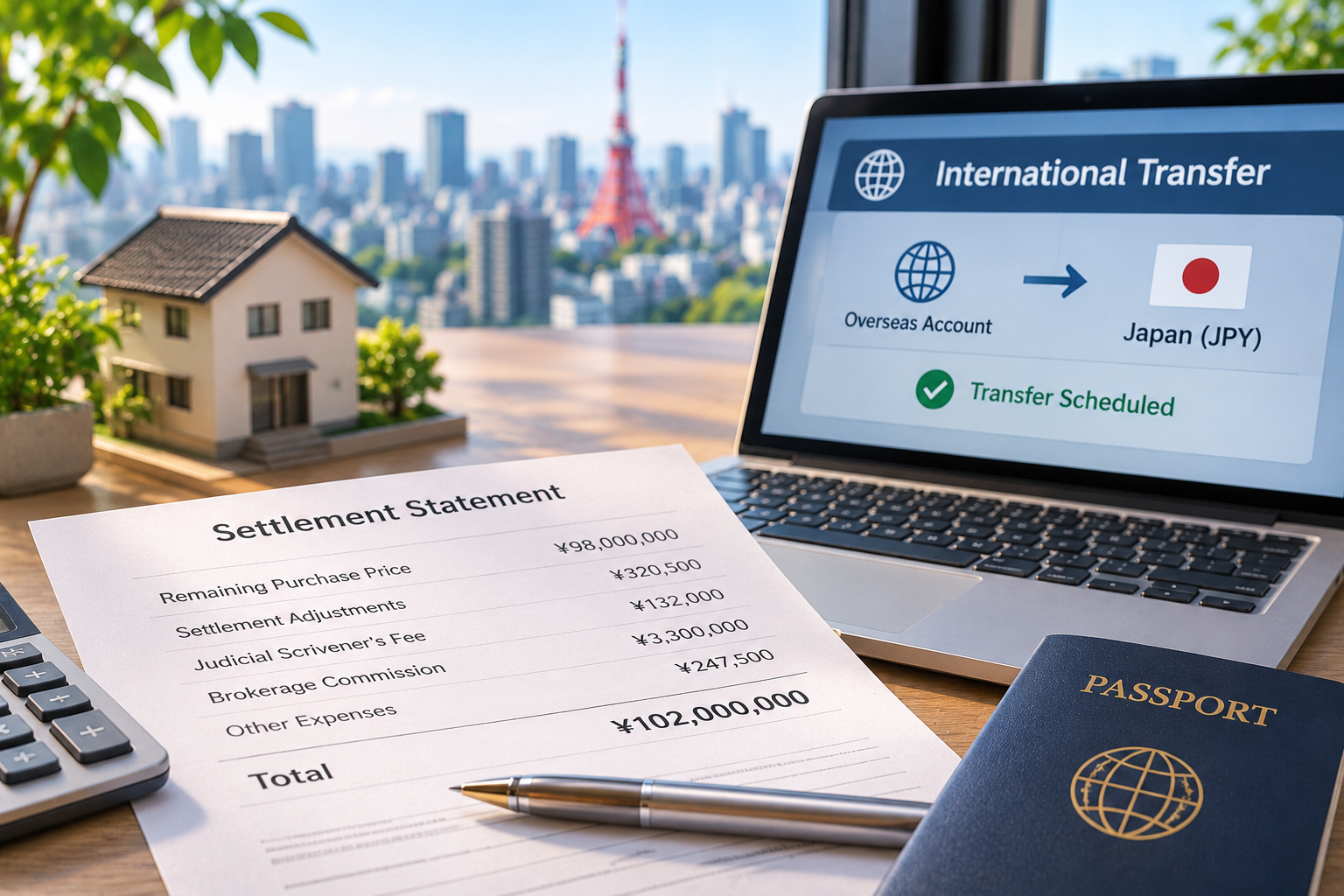
However, the total amount must be supported by a detailed breakdown, accurate down to the last yen. Banks may delay or reject a transfer if the amount does not match the supporting documentation.
In addition to the remaining purchase price and transaction expenses, settlement adjustments may include:
- Property taxes: Prorated fixed asset tax and city planning tax
- Condominium fees: Prorated management fees and repair reserve contributions
- Rental income: Prorated rent if the property is currently leased
These adjustments are typically calculated by the real estate agents based on the agreed settlement date.
We recommend requesting a detailed settlement statement as early as possible, including the remaining purchase price, adjustments, and all transaction expenses, so that the correct amount can be transferred in a single transaction.
4. When Should You Transfer the Funds?
Although we recommend preparing the funds well before settlement, this does not necessarily mean transferring them immediately after signing the purchase agreement.
Before sending a large amount, it is preferable to confirm that the seller’s identity and ownership verification have been completed, or at least that no significant issues are expected.
If settlement cannot proceed and the funds need to be returned, additional bank fees may apply. International refunds can also take longer than the original transfer.
For this reason, the ideal approach is to prepare the transfer arrangements early, confirm the seller’s readiness, and then send the funds with sufficient time for them to arrive before settlement.
Once the funds have arrived in Japan, they are ready to be distributed to the seller and other parties involved in the transaction on the settlement date, following the required procedures.
In our next article, Settlement, we will explain how these payments are coordinated on the day of settlement, how the ownership transfer and handover take place, and why the process follows this particular sequence.