In a previous article, we wrote about how an existing Hotel/Ryokan license can be transferred to a new operator.
This time, we want to focus on what happens in practice when the property changes hands: what should investors keep in mind when taking over the operations of an existing short-term rental business?
There are different ways to structure the transition, so this should be viewed as one practical example rather than the only way to do it. The following is based on what we have encountered through actual Hotel/Ryokan license transfers.
1. What You Need to Know Before the Transfer
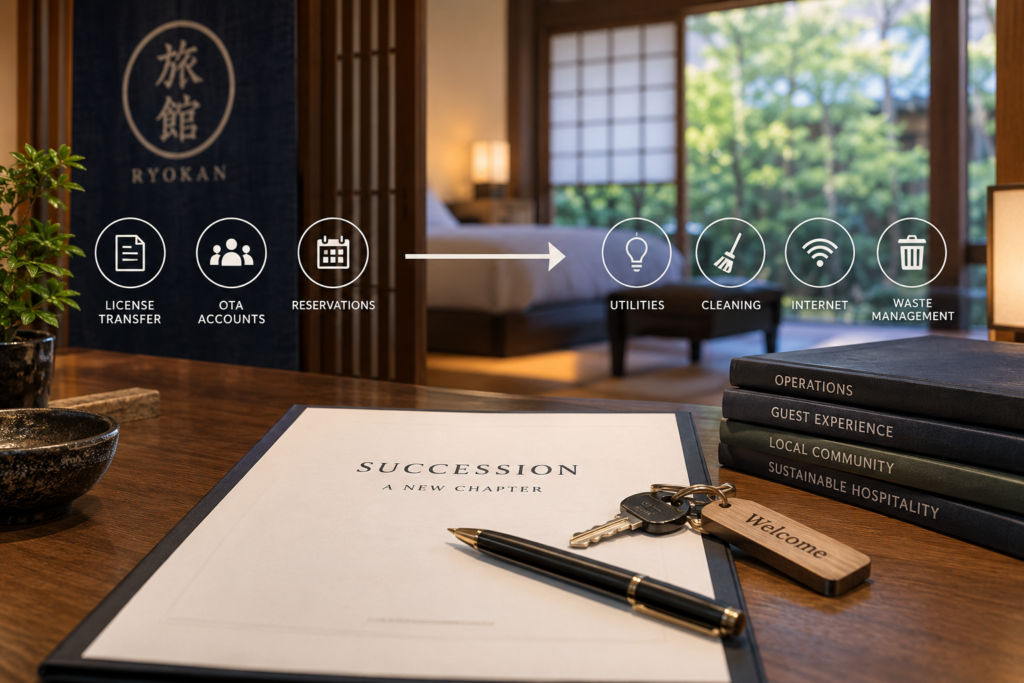
Transferring the Hotel/Ryokan license is only one part of the transition. OTA accounts, existing reservations, utilities, internet, cleaning and other operational arrangements also need to be transferred or reorganized.
There are several practical points that buyers should be aware of.
Airbnb
As a general rule, Airbnb accounts and listings cannot be transferred to a new owner or operator.
This means reservations after the settlement date require careful planning.
The buyer may operate through the seller’s existing listing as a co-host (if the seller’s operator approves), but a co-host has limited control over the listing. Alternatively, guests may be asked to cancel and rebook through a new listing, but Airbnb generally discourages hosts from asking guests to cancel existing reservations and may impose penalties in certain circumstances.
For this reason, once the sale is agreed, we generally recommend closing the seller’s Airbnb calendar for dates after the scheduled settlement date.
If possible, it can also be helpful to negotiate a provision in the purchase agreement allowing the buyer to begin accepting reservations for post-settlement dates through a new listing once the Hotel/Ryokan license has been transferred, even if settlement has not yet taken place.
This can help reduce the period with few or no reservations immediately after the acquisition.
Booking.com
Booking.com works differently.
Unlike Airbnb, an existing property’s Booking.com account can generally (and should) be transferred to the new operator.
In practice, this is particularly important because an address that has previously been registered on Booking.com cannot be registered again, even if the operator is different.
Internet and Utilities
Internet is easy to overlook because there is usually already a working connection at the property.
However, these contracts usually cannot be transferred. Establishing a new internet contract can take around one month, and installation typically requires someone to be physically present at the property. We therefore recommend arranging this well before settlement.
Electricity, gas and water can usually be switched relatively quickly, but the timing needs to be carefully coordinated if guests are staying during the transition.
For electricity, we often use TEPCO because the start time can be specified, making it easier to coordinate the switch without disrupting a guest’s stay.
Garbage Collection
Garbage collection is another area that should be checked rather than assumed.
Accommodation facilities need to arrange appropriate disposal of business waste. However, you should not assume that an existing accommodation business already has a proper waste collection contract in place.
We have encountered operators and cleaning companies that were not using an appropriate commercial waste collection service and were instead disposing of business waste as household waste — one example of the practices that have contributed to tighter regulations.
Finding a new provider can also be more difficult than expected. Some waste collection companies are not accepting new clients, while others are reluctant to work with short-term rental businesses.
For this reason, we recommend confirming the existing arrangement and identifying a suitable provider before settlement.
Existing Operating Procedures
The Hotel/Ryokan license also needs to be considered from an operational perspective.
The approved operation includes matters such as the check-in procedure and emergency response arrangements. After the Hotel/Ryokan license has been transferred, the new operator generally needs to continue operating in accordance with the approved structure.
If the new operator wants to change these procedures, a separate notification or other procedure may be required.
It is therefore important to understand how the property was originally approved to operate rather than assuming that everything can be changed immediately after acquisition.
Cleaning, Linen and Operational Devices
Cleaning arrangements can vary significantly between companies.
Some cleaning companies provide linen and cleaning supplies, while others use items belonging to the property. Some replenish guest amenities and consumables, while others only provide cleaning services.
Smart locks, security cameras and other operational devices should also be checked. Even if the physical device remains at the property, the associated account, subscription or administrator access may not automatically transfer to the new operator.
These arrangements should therefore be reviewed before settlement.
2. How We Recommend Handling the Transition
Ideally, the operational transition should start as soon as the purchase agreement is signed.
Existing reservations should be reviewed, post-settlement Airbnb availability should be controlled, and the buyer should begin arranging internet, utilities, cleaning, waste collection and other operational services before settlement.
The buyer and seller should also agree on how existing reservations will be handled, who will be responsible for each stay, and exactly when the operational transition will take place.
If possible, we also recommend agreeing with the seller that, once the Hotel/Ryokan license has been transferred, the buyer can begin accepting reservations for post-settlement dates through the new Airbnb listing even before settlement. This can help the new operator start with at least some reservations already in place.
Then, at settlement, the utilities and day-to-day operations can be switched to the new operator with as little disruption to guests as possible.
One important point we have learned from these transactions is that the seller’s cooperation may still be required even after settlement.
There may still be existing reservations, Booking.com procedures, device accounts or other operational matters that require assistance from the previous operator.
For this reason, when purchasing an operating hotel or ryokan, we recommend considering not only the property, its financial performance and whether the Hotel/Ryokan license can be transferred, but also whether the seller will cooperate with a smooth operational transition after settlement.
For properties purchased through Jin’s Homes, we coordinate these operational arrangements as part of the transition. We also provide the same scope of support when setting up a new minpaku, hotel or ryokan. If you are interested in purchasing a short-term rental property in Tokyo — whether already licensed or to be newly set up — please feel free to contact us.