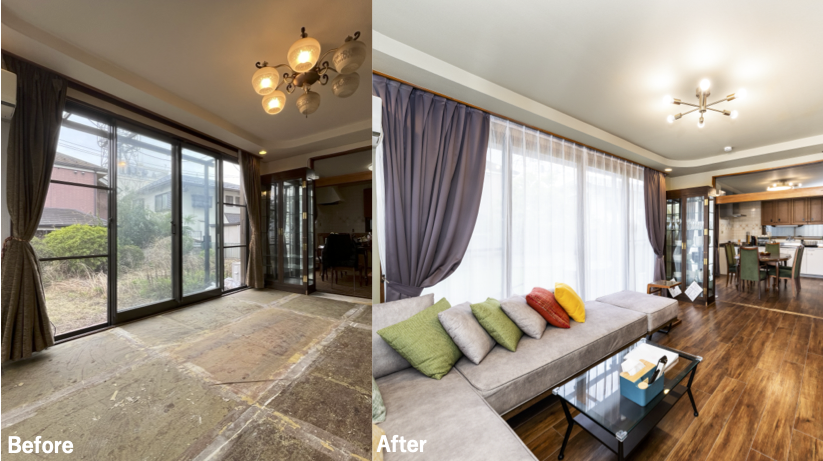
Recently, we took over the management of an operating short-term rental.
I will write about the details in another article, but put simply: it was operating illegally.
The owner had purchased the property specifically to operate it as a licensed short-term rental. The real estate agent knew this.
Despite that, the agent introduced a house that did not satisfy the requirements for either a minpaku registration or a hotel license.
As a result, the previous owner was only able to obtain approval by making false statements during the application process.
We are now in the process of correcting the issues and reapplying properly.
But before getting into that story, I want to share something much more important: how to avoid making the same mistake in the first place.
The good news is that you do not need to know every detail of the law or become an expert in regulations before buying.
Even if you accidentally choose a property that does not meet the requirements, there is still a way to stop the purchase before it is too late.
All you need to do is add one extra step to the normal purchase process.
Add This Condition to Your Purchase Offer
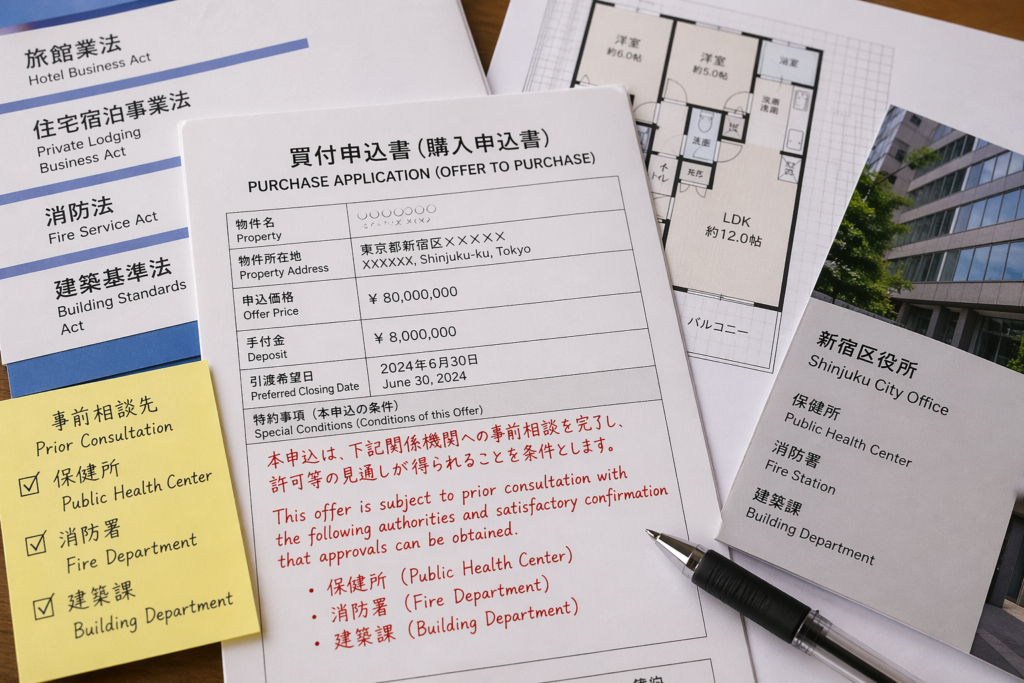
When you submit your purchase application or letter of intent, make the purchase conditional upon completing prior consultations with:
- The public health center
- The fire department
- The building department
In other words, before you commit to buying the property, require confirmation from all three authorities.
For both minpaku registrations and hotel licenses, you ultimately need approval from each of these departments.
And in every case, the process begins with a prior consultation.
If the property does not satisfy the requirements, this is usually where you will find out.
For example, the authorities may tell you that:
- Local regulations only allow 60, 90, or 120 days of operation per year
- The road width or legal road access is insufficient
- The staircase, corridor width, or other building features do not comply
- The building cannot satisfy the required fire safety standards
- Local rules require the operator to remain physically present on-site
The important point is that if you make these consultations a condition of the purchase, you can cancel the purchase before losing your deposit or buying a property that can never legally operate.
Even a “Maybe” Is Valuable
Sometimes the answer will not be “impossible.”
Instead, you may be told that the property can be licensed, but only after expensive correction work.
For example, you may need to install additional walls, widen a corridor, or carry out other construction work costing several million yen.
If you know this in advance, you can renegotiate the price accordingly — or simply walk away if it no longer makes financial sense.
There Is Another Benefit
Prior consultations do not just reduce risk.
In many cases, the public health center, fire department, and building department will provide written comments or a checklist showing exactly what is required.
You will have written guidance to rely on during the application process, and something concrete to refer back to if different instructions are given later.
By adding this extra step, you not only avoid buying the wrong property, but also make it easier to plan ahead and move through the approval process more efficiently.
Do Not Assume an Existing License Means the Property Is Safe
There are two points that many buyers misunderstand.
First, a hotel license can generally be transferred to a new owner, but a minpaku license cannot. This means, even if the seller is licensed, if there was a policy change since the seller got the license, you may not qualify for another license.
Second, in some areas such as Taito-ku, local rules require the operator to stay on-site 24-7, and I’ve heard many stories where the seller registers their residency under the same just to obtain the license. This means, If you don’t do the same, you may not be able to maintain the license moving forward.
So do not assume that a property is safe simply because it is advertised as “licensed.”
The property may already be operating illegally without the buyer realizing it.
Why This Happens So Often
After confronting the real estate agent who introduced this property, he eventually admitted that he simply “did not know” the rules.
Real estate agents may be experts in buying and selling properties, but unless they have direct experience operating and managing short-term rentals, they often know very little about practical requirements on the Minpaku and Hotel Business Act.
Imagine spending months searching, showing up to view multiple properties, and getting emotionally invested, only to discover at the end that the property can never legally operate as intended. You may have even lost a potential deal.
If you are considering a property for short-term rental, we strongly recommend working with a real estate company that is actively involved in day-to-day operations and management — not only for the license but also to identify favourable properties for actual operation.
That one difference can determine whether your purchase becomes a successful investment or an expensive mistake.